Planning a Safe Dive
Gas Management, Depth, and Communication
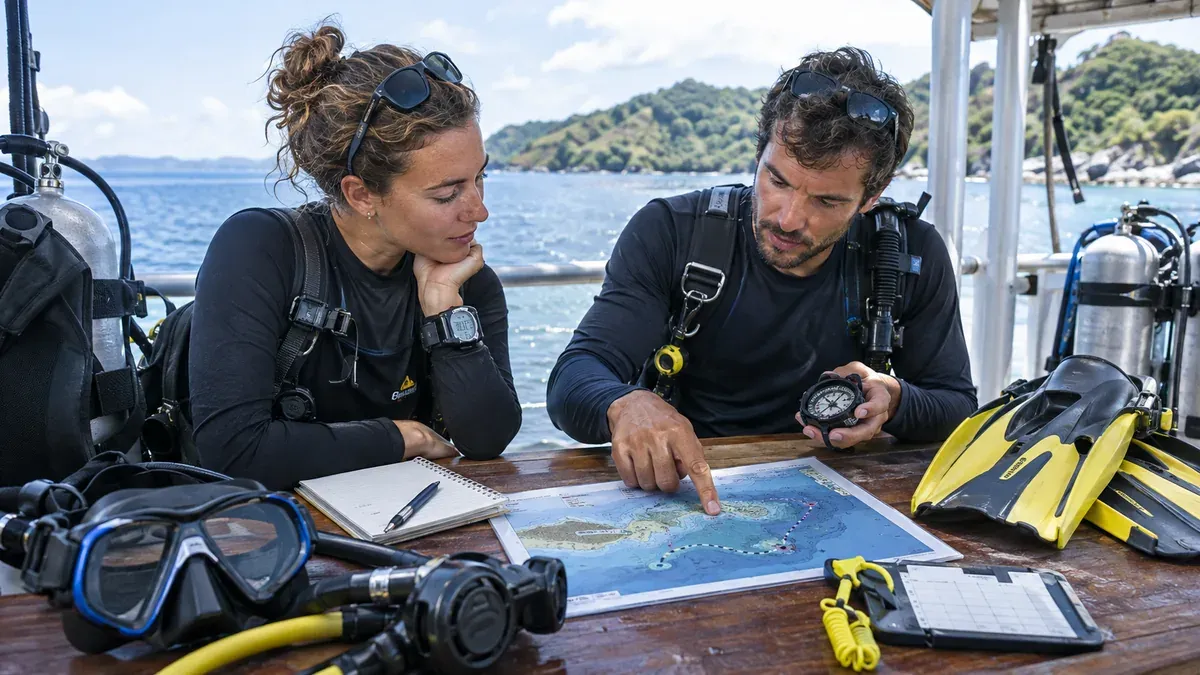
Scuba diving is a fascinating activity that allows you to explore a completely different world, but this privilege comes with the responsibility of ensuring safety on every descent.
The golden rule in this discipline is universal and admits no exceptions: "Plan your dive and dive your plan." A successful dive is not measured by the amount of marine life sighted, but by the team's ability to return to the surface safely and without setbacks. To achieve this, there are three fundamental pillars that every diver, from entry-level to technical, must master: gas management, depth control, and effective communication with the buddy.
Underwater incidents are rarely the result of a sudden equipment failure; in the vast majority of cases, they result from a chain of small human errors and oversights on the surface.
The Preventive Role of Planning in Diving
Taking time to prepare a detailed plan before gearing up greatly reduces stress, helps prevent hasty decisions under the effects of narcosis, and sets clear expectations for the whole team. Clear planning covers more than the underwater route: it also establishes the absolute limits of the dive and the strict emergency procedures to follow if anything unexpected happens.
Gas Management: The Most Critical Resource
Air is the resource that defines the time and viability of any underwater exploration. Running out of gas is not an unforeseeable accident, but a direct failure in planning and monitoring.
The Rule of Thirds
For dives in environments where the entry point is the same as the exit point (such as from a shore or an anchored boat with no favorable current), the most prudent strategy is the "Rule of Thirds." This principle divides the total tank pressure into three equal parts:
- First third: For the outward journey or initial exploration.
- Second third: Reserved for the return journey to the ascent point.
- Third third: An untouched emergency reserve, intended to handle unexpected situations, delays, or the need to share gas with a buddy during the ascent and safety stop.
- 1/3 outward
- 1/3 return
- 1/3 reserve
Surface Air Consumption (SAC) Calculation
Knowing the Surface Air Consumption (SAC) rate allows divers to predict how much gas they will use at a given depth. Consumption varies greatly depending on the individual, workload, currents, water temperature, and stress. When planning, the consumption of the diver who uses the most air in the team should be taken as a reference, thus ensuring that the dive ends based on the most conservative limit.
Depth Control and No-Decompression Limits (NDL)
Depth not only affects gas consumption, which increases proportionally with ambient pressure, but it also dictates the maximum time a diver can remain underwater without requiring mandatory decompression stops.
Establishing Maximum Depth
The maximum depth must be agreed upon before entering the water, taking into account the divers' certification, their recent experience, and the environmental conditions. Exceeding this limit exponentially increases the risk of decompression sickness and aggravates the effects of nitrogen narcosis.
Attention to Narcosis - Nitrogen narcosis is a temporary alteration that can cloud judgment, create a false sense of euphoria, and slow reflexes, commonly manifesting from depths of 30 meters. Respecting the agreed limits is the only way to mitigate this risk.
Constant Monitoring and Redundancy
Although modern dive computers are extraordinary tools that calculate nitrogen absorption in real time, planning should never be completely delegated to electronics. It is vital to know the projected No-Decompression Limit (NDL) for the planned maximum depth before jumping into the water. Additionally, a maximum bottom time must be agreed upon to initiate a controlled ascent, ensuring enough margin is left to perform a 3 to 5-minute safety stop at a depth of 5 meters.
Underwater Communication: Uninterrupted Contact
The buddy system is the primary safety net in recreational diving. However, a buddy who does not communicate is ineffective in an emergency.
Standardization of Hand Signals
Underwater, body language and hand signals replace the voice. Before the dive, the team must review essential signals, especially if the divers come from different certifying agencies. Signals such as "OK," "How much air do you have?", "Half tank," "Ascend," "Descend," and "Turn around" must be unequivocal. Communication must be proactive: one should not wait for the computer to alert that gas is running low to inform their buddy.
Buddy Separation and Loss Protocol
The loss of visual contact is a stressful situation that requires a standardized response. The dive plan must include a clear protocol: search for the buddy for no more than one minute (360 degrees, looking up and down). If there is no visual contact after that time, both divers must initiate a controlled ascent to the surface at a safe speed, omitting the safety stop if necessary, to reunite at the top. Searching tirelessly underwater increases the risk of running out of gas or becoming disoriented.
The Pre-Dive Check as a Final Safeguard
No planning is complete without the cross-checked safety review prior to entering the water. Checking the buddy's equipment ensures that everything is correctly configured and operational.
- BCD (B): BCD and inflator operation.
- Weights (W): Belt or quick release operational.
- Releases (R): Buckles and straps adjusted.
- Air (A): Valves open and regulators tested.
A safe dive is an uneventful dive when it comes to emergencies. When gas is managed conservatively, depth limits are carefully respected, and communication remains constant, attention can focus on enjoying the marine environment.
Thorough preparation on the surface provides true freedom underwater, allowing each exploration to end as it should: with a calm ascent, plenty of air left in the tank, and the team ready to plan the next adventure.