Nitrox Made Simple: More Time Underwater, but Not More Depth
The benefits, limits and mistakes every diver should understand before using an oxygen-enriched breathing mixture.
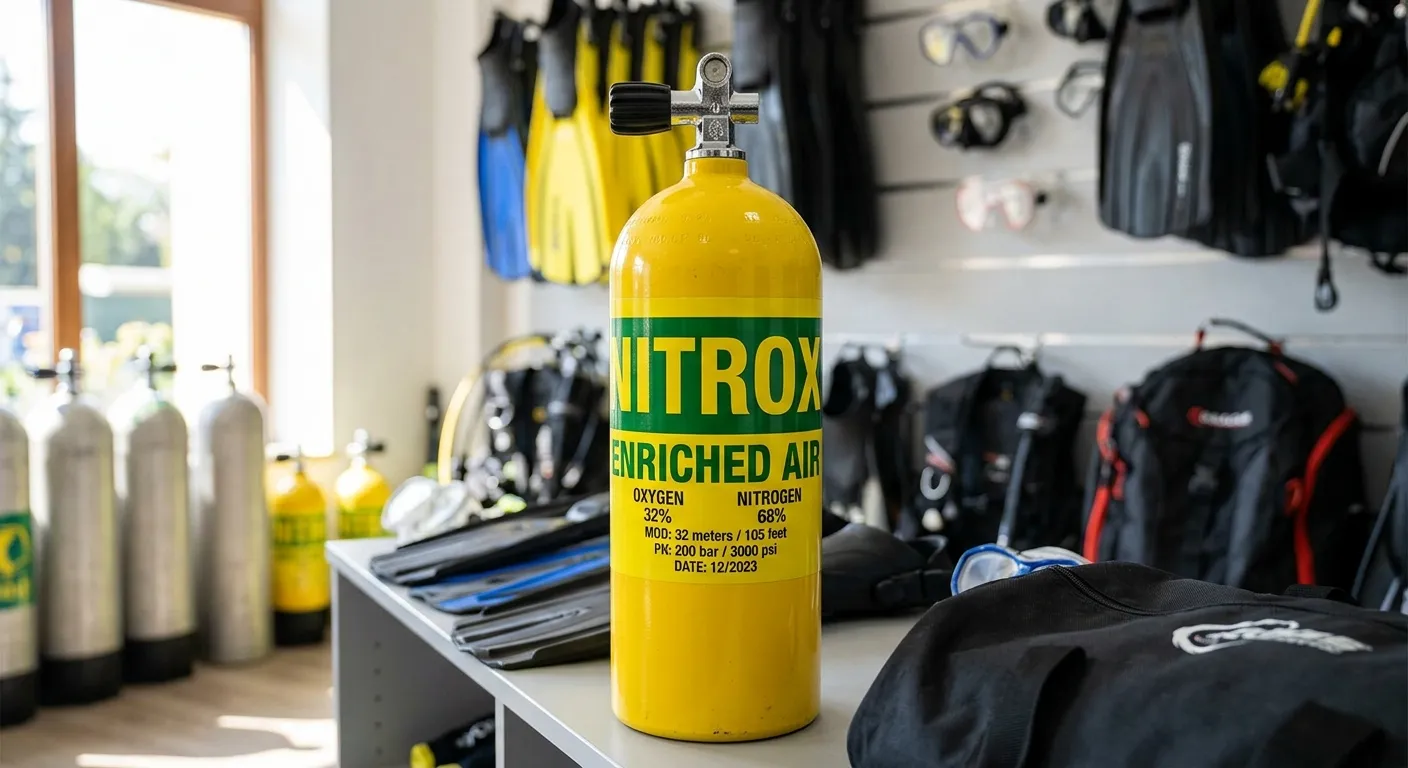
Less N₂
Reduces the proportion of nitrogen breathed during the dive.
More Bottom Time
May extend the no-decompression limits at a given depth.
Lower MOD
The higher the oxygen content of the mixture, the shallower its maximum operating depth.
What Is Nitrox?
Nitrox, also known as enriched air or EANx, is a mixture of oxygen and nitrogen containing a higher percentage of oxygen than normal air. Its primary purpose is to reduce the diver’s exposure to nitrogen.
The air we breathe contains approximately 21% oxygen. The most commonly used recreational diving mixtures are EAN32 and EAN36.
COMMON MIXTURES
EAN32
32% oxygen
68% nitrogen
EAN36
36% oxygen
64% nitrogen
As the percentage of oxygen increases, the proportion of nitrogen decreases. This reduces the amount of nitrogen absorbed by the body during the dive.
Nitrox is not intended for diving deeper. It is a tool for managing nitrogen exposure more effectively.
What Is Nitrox Used For?
Its main purpose is to increase the time available within the no-decompression limits at a given depth.
It is particularly useful when the no-decompression limit may be reached before the breathing gas in the cylinder runs out. Although nitrox does not eliminate the risk of decompression sickness, it may reduce nitrogen exposure when used correctly.
IT MAY BE USEFUL FOR
Completing several dives throughout the same day.
Reducing accumulated nitrogen loading. Following a more conservative dive profile.
Extending photography or exploration dives.
IT DOES NOT ELIMINATE
The risk of decompression sickness. The need to control the ascent.
Safety stops and proper dive planning.
The effects of exertion, cold or hydration.
Main Benefit: Reduced Nitrogen Absorption
During a dive, the body absorbs nitrogen because of the increase in ambient pressure. The greater the depth and exposure time, the more nitrogen the body absorbs.
Because nitrox contains less nitrogen than air, it may extend the no-decompression limits at the same depth. It can also be used without extending bottom time by following air-based limits and adopting a more conservative dive profile.
Nitrox Does Not Allow You to Dive Deeper
This is one of the most common misconceptions. Nitrox may allow more time at certain depths, but its maximum operating depth is normally shallower than that of air.
The reason is the partial pressure of oxygen. When it becomes too high, oxygen can become toxic to the central nervous system.
In recreational diving, a maximum partial pressure of oxygen of 1.4 ATA is commonly used during the active phase of the dive.
What Is Maximum Operating Depth?
Maximum operating depth, or MOD, is the maximum depth at which a breathing mixture can be used without exceeding the planned partial pressure of oxygen.
34 m
Approximate MOD for EAN32 at a ppO₂ of 1.4 ATA.
29 m
Approximate MOD for EAN36 at a ppO₂ of 1.4 ATA.
CRITICAL RISK Exceeding the MOD increases the risk of central nervous system oxygen toxicity. In severe cases, this may cause a seizure underwater, creating a risk of losing the regulator and drowning.
Does Nitrox Reduce Tiredness?
Some divers report feeling less tired after diving with nitrox. However, this feeling should not be regarded as a guaranteed benefit or used as a reason to change the dive plan.
The main benefit of nitrox remains the reduction of nitrogen exposure for a given depth and dive time.
Common Mistakes When Diving with Nitrox
Not Personally Analysing the Cylinder
Every diver must verify the actual oxygen percentage using an oxygen analyser before using the cylinder. The cylinder label does not replace personal analysis.
Failing to Identify the Mixture Correctly
The cylinder should be labelled with the oxygen percentage, MOD, analysis date and diver identification.
Incorrectly Setting the Dive Computer
The dive computer must be configured with the actual oxygen percentage. An incorrect setting affects the calculation of no-decompression limits and oxygen exposure.
Believing Nitrox Prevents Decompression Obligations
Nitrox reduces nitrogen loading, but it does not eliminate the risk. It is still possible to enter decompression while using enriched air.
Other Mistakes to Avoid
Choosing the Wrong Mixture
The mixture with the highest oxygen percentage is not always the best option. The percentage must be selected according to the planned maximum depth and the complete dive profile.
Exceeding the MOD, Even Briefly
The MOD is not an approximate recommendation. A downcurrent or poor buoyancy control may cause a diver to exceed the limit without immediately noticing.
Using Nitrox as a Substitute for Dive Planning
The breathing gas cannot compensate for a rapid ascent, poor buoyancy control, insufficient gas reserves or a badly planned dive profile.
Is Certification Required?
Divers must receive specific training before using enriched air. Nitrox certification teaches divers how to understand and manage the risks associated with an increased oxygen concentration.
TRAINING INCLUDES
Analysing the oxygen content.
Calculating the MOD.
Configuring the dive computer.
Monitoring oxygen exposure.
Selecting the appropriate mixture.
Labelling the cylinder correctly.
When Is Diving with Nitrox Worthwhile?
Nitrox is particularly useful on diving holidays involving several dives per day, liveaboard trips and repetitive dive profiles carried out at depths of approximately 18 to 30 metres.
On very shallow dives, gas consumption may become the limiting factor before the no-decompression limit is reached. On deeper dives, the MOD may prevent certain mixtures from being used.
Nitrox should therefore be selected according to the actual dive profile, rather than simply because it is available.
Diving Holidays
Useful when completing several dives over a period of a few days.
Mid-Range Depth Profiles
Particularly beneficial at depths where the no-decompression limit restricts bottom time.
Conservative Planning
May reduce nitrogen exposure without extending bottom time.
Nitrox and Diving Safety
Nitrox can provide an additional safety margin when used correctly. However, it does not replace proper training, equipment maintenance, buoyancy control or responsible dive planning.
Before entering the water, analyse the cylinder, confirm the mixture, calculate the MOD, configure the dive computer and follow the dive plan.
Pre-Dive Check
Personally analyse the mixture.
Record the oxygen percentage.
Calculate and mark the MOD.
Configure the dive computer.
Review the planned depth, time and gas reserves.
Confirm the dive plan with your buddy.
Diving Insurance and Specialist Assistance
Using nitrox correctly reduces certain risks, but it cannot prevent every diving accident. An incident may require medical assessment, evacuation, search and rescue services or treatment in a hyperbaric chamber.
For this reason, divers should have diving insurance that includes specialist assistance, medical expenses, hyperbaric treatment, search and rescue, and repatriation when required.
Conclusion
Nitrox contains more oxygen and less nitrogen than air. Its main benefit is that it may extend the no-decompression limits or reduce nitrogen loading during repetitive diving. Its main limitation is the MOD: the higher the oxygen percentage, the shallower the maximum depth at which the mixture can be used. Proper training, personal cylinder analysis, correct dive-computer configuration and strict adherence to the dive plan are essential for using nitrox safely.
This content is provided for general information purposes. Enriched-air dive planning and use must follow the diver’s training, the procedures established by the relevant training organisation and the dive-computer manufacturer’s instructions.