


The 4 Most Useful Diving Specialties
Nitrox · Buoyancy · Deep Diving · Night Diving A technical guide to choosing training with practical applications
Obtaining an Open Water Diver certification is only the beginning of a diver’s training. Diving specialties allow divers to refine specific skills, access new environments and manage certain risks more effectively.
However, not every specialty is equally useful for every diver. The courses with the most practical applications include Nitrox diving, buoyancy control, deep diving and night diving.
The right choice will depend on the type of dives undertaken, the diver’s experience and their personal objectives.
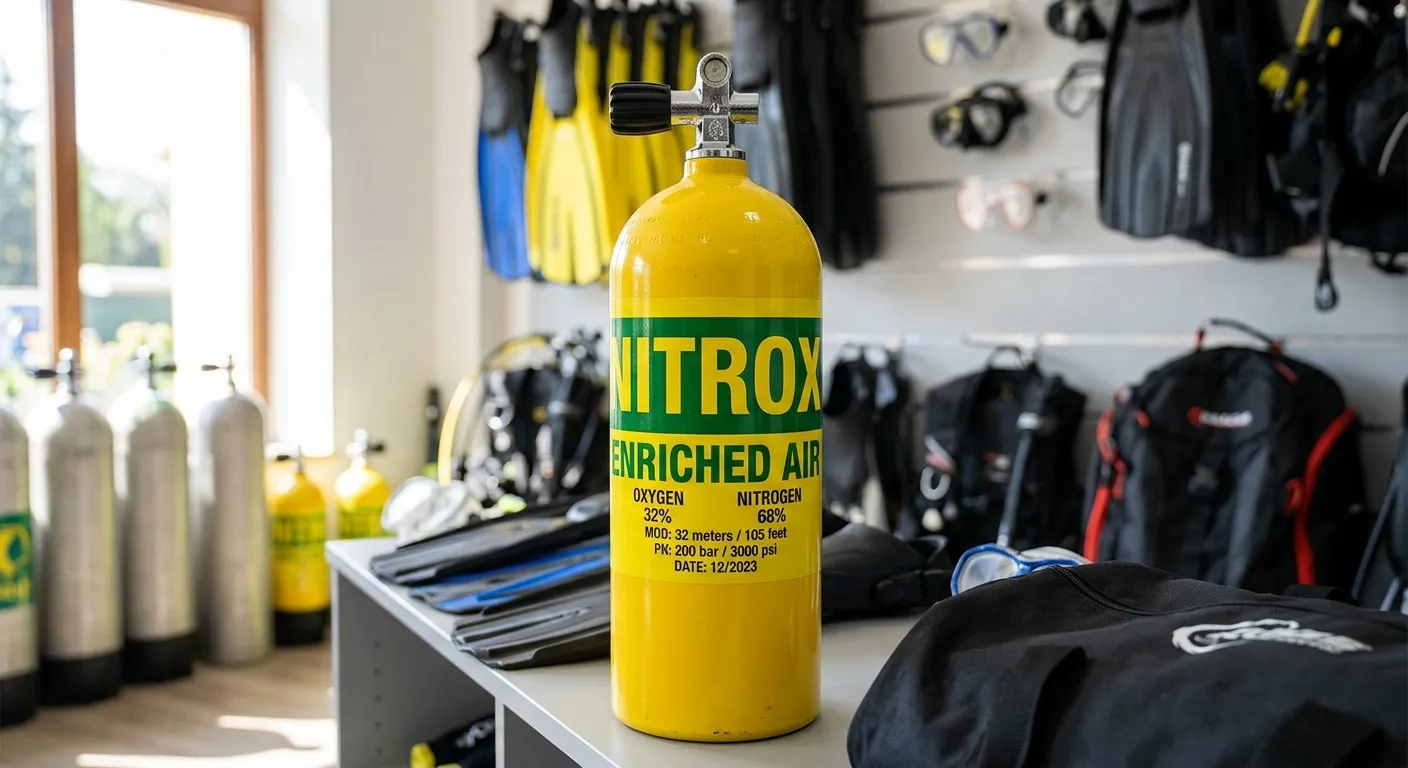
1. Nitrox Specialty: More Time Within the Limits
Nitrox, also known as enriched air or EANx, is a breathing gas mixture containing more than 21% oxygen, the proportion found in normal air.
The most common Nitrox mixtures in recreational diving are EAN32 and EAN36, containing 32% and 36% oxygen respectively.
Because these mixtures contain less nitrogen, the diver absorbs less during the dive. This can extend the no-decompression limits compared with air or allow the same dive profile with reduced nitrogen exposure.
Key Point - Nitrox can be used either to extend the available time or to increase the safety margin, depending on how the dive is planned. It does not eliminate the risk of decompression sickness.
What Do You Learn on a Nitrox Course?
- Analysing the oxygen percentage in the cylinder.
- Labelling and identifying the gas mixture.
- Configuring the dive computer.
- Calculating the maximum operating depth.
- Monitoring cumulative oxygen exposure.
- Planning repetitive dives.
Each diver should personally analyse their cylinder or verify the analysis before using it. The dive computer must also be configured correctly, as leaving it set to air can produce incorrect calculations.
Maximum Operating Depth
The higher oxygen concentration introduces an additional limit: the partial pressure of oxygen.
MOD = (maximum partial pressure ÷ oxygen fraction − 1) × 10
Using a maximum partial pressure of 1.4 ATA: EAN32 ≈ 34 m · EAN36 ≈ 29 m
Exceeding the mixture’s maximum operating depth increases the risk of central nervous system oxygen toxicity, which may cause visual disturbances, nausea, muscle twitching or convulsions. Nitrox therefore does not allow deeper diving than air; some mixtures reduce the maximum available depth.
Who Is It Particularly Useful For?
- Trips involving several dives per day.
- Liveaboard diving trips.
- Repetitive dives between 18 and 30 metres.
- Underwater photography.
- Wreck or reef dives with extended bottom times.
It is less useful on very shallow dives, where the no-decompression limit usually far exceeds the cylinder’s available gas supply.
2. Buoyancy Specialty: The Foundation of Efficient Diving
Buoyancy is probably the skill with the greatest overall impact on the quality of a dive.
A diver with good control can maintain a stable depth, move with less effort and avoid unintended ascents or descents. Good control also reduces the risk of hitting the bottom, disturbing sediment or damaging marine organisms.
Buoyancy specialties focus mainly on weighting, trim, breathing and body positioning. These skills reduce physical effort and improve gas-consumption efficiency.
What Is Practised During the Course?
- Checking the correct amount of weight.
- Distributing the weights correctly.
- Maintaining a horizontal position or good trim.
- Maintaining neutral buoyancy without using the hands.
- Performing controlled descents and ascents.
- Hovering at different depths.
- Controlling buoyancy through breathing.
- Using efficient finning techniques.
Weighting and Control - Carrying too much weight requires more air in the buoyancy compensator, increases drag and makes volume changes during the ascent more difficult to control. Insufficient weight can make the safety stop difficult at the end of the dive.
Who Is It Recommended For?
A buoyancy specialty is useful for almost every diver, but particularly for those who:
- Use their gas quickly.
- Have difficulty maintaining a stable depth.
- Frequently use their hands while swimming.
- Swim in a vertical position.
- Disturb sediment with their fins.
- Want to begin underwater photography, wreck diving or deep diving.
It is one of the most useful specialties to complete after the Open Water Diver course because it directly improves the skills used on every subsequent dive.
3. Deep Diving: Beyond 18 Metres
In recreational diving, any dive below 18 metres is generally considered a deep dive.
Depending on the diver’s certification level and training agency, a recreational diver may progress to a maximum depth of 40 metres. This training does not turn a recreational dive into technical diving or authorise the diver to exceed the no-decompression limits.
Going deeper involves more than equalising the ears and controlling the buoyancy compensator. Depth affects gas consumption, breathing-gas density, perception, nitrogen exposure and the time available.
Specific Risks of Deep Diving
- Gas is consumed more quickly.
- No-decompression limits become shorter.
- Nitrogen exposure increases.
- Nitrogen narcosis may occur.
- Breathing becomes more demanding.
- Mistakes have more immediate consequences.
- Less time is available to solve problems.
Pressure and Gas Consumption - At 30 metres, ambient pressure is approximately four times greater than at the surface. Under equivalent conditions, gas consumption will also be approximately four times the surface consumption rate.
Nitrogen narcosis may become noticeable at around 30 metres, although its intensity varies between individuals and may change from one dive to another. It can cause slower thinking, overconfidence, anxiety or difficulty performing simple tasks.
What Do You Learn in the Specialty?
- Planning gas consumption.
- Depth and time limits.
- Managing gas reserves.
- Recognising nitrogen narcosis.
- Ascent procedures.
- Safety stops.
- Use of alternate air sources.
- Procedures for an unplanned decompression obligation.
- Configuring and interpreting the dive computer.
The objective is not to reach 40 metres on every dive, but to understand when a deep dive can be carried out and when it should be cancelled.
Who Is It Useful For?
This specialty is suitable for divers who want to visit:
- Wrecks located at greater depths.
- Underwater walls.
- Deep reefs.
- Geological formations located farther below the surface.
- Dive sites deeper than their current certification limit.
Before beginning, divers should have good buoyancy control, controlled-ascent skills and a basic understanding of gas management.
4. Night Diving Specialty: Navigation and Communication in the Dark
A night dive completely transforms a familiar dive site. Many species change their behaviour, and organisms that remain hidden during the day become visible.
Darkness also removes visual references, makes navigation more difficult and changes the way divers communicate with their buddies.
For this reason, the training involves more than using a dive light. It includes specific navigation procedures, signals, dive planning and responses to light failures.
Essential Equipment
In addition to the standard equipment, a night diver should carry:
- A primary dive light.
- A backup dive light.
- A dive computer with an illuminated display.
- A compass.
- Surface-signalling devices visible at night.
- Suitable thermal protection.
Entry and exit points should be clearly identified. During a shore dive, a fixed light may be installed as a reference. From a boat, the anchor line or ladder may be marked with lights or strobes.
Communicating With a Dive Light
Signals are given by illuminating the hand or tracing agreed movements with the beam.
Avoid Dazzling - Never point the light into your buddy’s eyes; it can temporarily impair night vision.
Before entering the water, divers should also agree on:
- The “OK” signal.
- The attention signal.
- The emergency signal.
- The procedure to follow if a dive light fails.
- The procedure to follow in the event of separation.
- The planned exit point and latest exit time.
Who Is It Recommended For?
The night-diving course is particularly useful for divers who:
- Frequently dive from shore.
- Take part in diving trips or liveaboards.
- Want to observe nocturnal marine life.
- Need to improve their navigation skills.
- Want to become more confident in low-visibility conditions.
Although a night dive may be shallow, it requires calmness, good buoyancy control and constant communication.
Which Diving Specialty Should You Complete First?
There is no compulsory order, but a practical progression would be:
- Buoyancy, to improve body control and gas consumption.
- Nitrox, to optimise repetitive dives and bottom times.
- Deep diving, to expand the diver’s depth range progressively.
- Night diving, to develop navigation and communication without visual references.
This order is not universal. A diver who regularly takes trips involving several dives per day may benefit from completing the Nitrox specialty first. A diver who mainly dives from shore may prioritise night-diving training.
The choice should be based on the dives the person genuinely intends to undertake, rather than simply on collecting certifications.
Training, Experience and Diving Insurance
A certification expands a diver’s knowledge, but it does not replace progressively acquired experience.
After completing a specialty, the new skills should be practised in straightforward conditions before being applied on more demanding dives.
Reviewing Your Coverage - Review the terms of your diving insurance policy. Some policies set depth limits, certification requirements or exclusions for certain activities. Check that the planned dive is within your training, experience and coverage.
Conclusion
The most useful diving specialties are those that improve skills with practical applications in real diving situations.
Buoyancy provides a technical foundation for every type of diving. Nitrox helps divers manage nitrogen exposure more effectively. Deep-diving training teaches divers to plan dives with a smaller margin for error. Night-diving training prepares divers to navigate and communicate without natural light.
The best specialty is not necessarily the most advanced. It is the one that allows divers to complete their next dives with greater control, preparation and safety.
