


How to Equalise Your Ears While Diving: Techniques and Common Mistakes
Equalising early, frequently and without forcing helps prevent pain, barotrauma and the need to abort the dive.
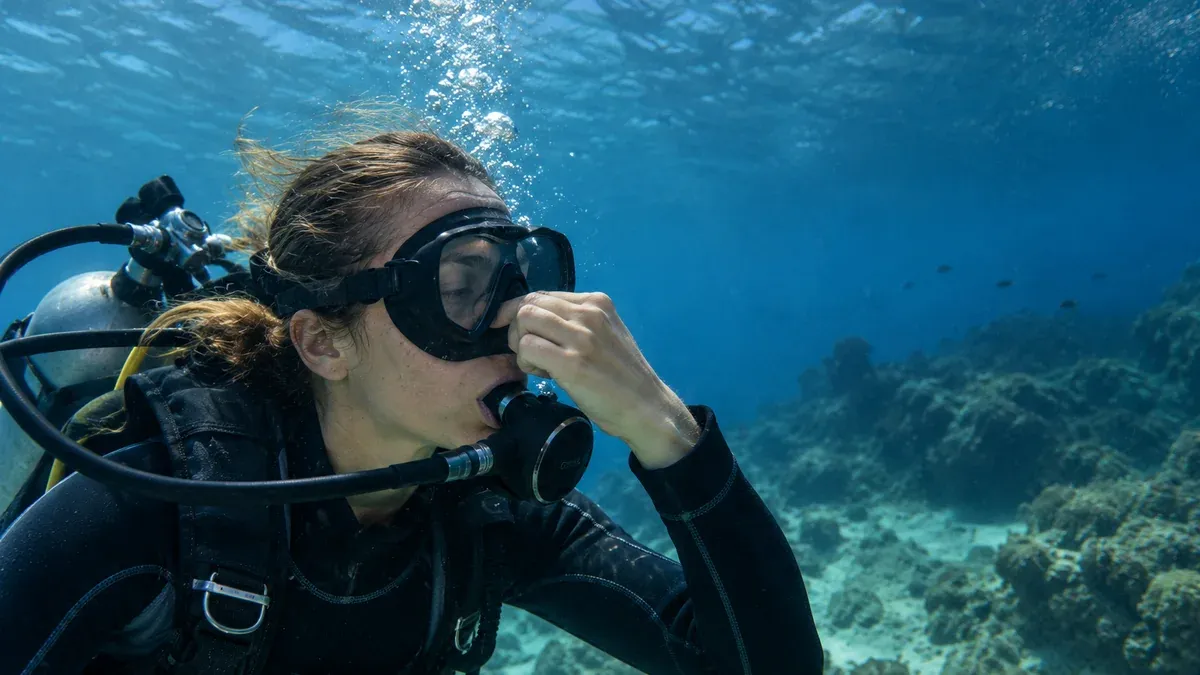
As you descend, ambient pressure increases and compresses the air in the middle ear. To equalise the pressure, the diver must allow air to enter through the Eustachian tubes. Waiting until you feel pain or forcing the manoeuvre increases the risk of injury.
The basic rule - Equalise before you feel discomfort, repeat the manoeuvre throughout the first few metres and stop descending if one ear does not respond.
Why Do You Need to Equalise?
The middle ear is an air-filled cavity behind the eardrum. During descent, external pressure rises rapidly, especially in the first few metres. If the internal pressure is not equalised, the eardrum is pushed inwards and may cause pain, inflammation, bleeding and, in the worst cases, a ruptured eardrum.
Equalisation problems can therefore begin even at shallow depth. The technique must be preventive, not a reaction to pain.
When and How to Equalise
- Perform a first gentle equalisation at the surface.
- Descend slowly, preferably in an upright position.
- Equalise every half metre to one metre during the first few metres.
- If you feel pressure, stop and ascend slightly.
- Continue only when both ears are equalised and pain-free.
Do Not Wait for Pain - Once the pressure difference is high, the Eustachian tubes may become blocked. Blowing harder will usually not solve the problem and may cause injury.
Ear Equalisation Techniques
There is no single technique that works for everyone. Practise several and use the one that equalises pressure with the least effort.
Valsalva
Pinch your nose and blow gently, as though trying to exhale through it. It is simple, but must never be forced.
Toynbee
Pinch your nose and swallow. Swallowing activates the muscles that help open the Eustachian tubes.
Frenzel
With your nose pinched and your glottis closed, use your tongue like a piston, as if pronouncing the letter “K”. It is precise and requires practice.
Lowry
Combine Valsalva and Toynbee: pinch your nose, blow gently and swallow at the same time.
Edmonds
Move your jaw forwards, gently tense your throat and combine the movement with Valsalva or Frenzel.
Voluntary Tubal Opening
Tense the soft palate and throat as if beginning to yawn. Once mastered, it allows almost continuous equalisation.
What Should You Do if One Ear Does Not Equalise?
- Stop your descent.
- Ascend a few centimetres until the pressure disappears.
- Keep your head upright, move your jaw and swallow.
- Try another technique, always gently.
- Abort the dive if you cannot equalise without pain.
Common Mistakes to Avoid
Waiting Until It Hurts: Equalisation should begin before discomfort appears.
Blowing Too Forcefully: A forceful Valsalva can damage the middle or inner ear.
Descending Too Quickly: This reduces the time available to correct the pressure.
Diving While Congested: A cold or allergy can block the Eustachian tubes.
Relying on Decongestants: Their effect may wear off during the dive and cause a reverse block on ascent.
Using Standard Earplugs: They create a sealed air space in the ear canal and can cause external-ear barotrauma.
When to Abort the Dive
Do not continue diving if you experience persistent pain, intense ear fullness, hearing loss, tinnitus, vertigo, fluid or blood. These signs may indicate barotrauma and require medical assessment.
Urgent Medical Attention - Severe vertigo, sudden hearing loss or balance problems may indicate an inner-ear injury. Do not dive again until you have been assessed by a medical professional.
Pre-descent Checklist
- I can equalise both ears at the surface.
- I will descend slowly and under control.
- I will abort the dive if I cannot equalise without pain.
- I have no nasal congestion or cold symptoms.
- I will equalise before I feel pressure.
Diving Safety and Accident Cover
Correct technique reduces the risk but does not prevent every incident. Barotrauma may require a medical examination, diagnostic tests or specialist treatment.
Technical sources: Divers Alert Network (DAN), “Middle-Ear Equalization”, “6 Methods to Equalize Your Ears” and “Middle-Ear Barotrauma”. Informational content. It does not replace training from an instructor or assessment by a healthcare professional.
